Deconstructing The Bootstrap Argument
YOU KNOW IT BY HEART.
-
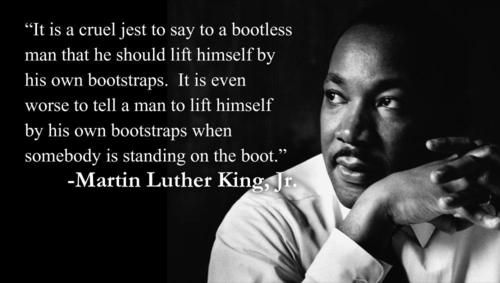
Pull yourself up by your bootstraps!
-
I did it and so can you.
-
The playing field is level.
Except the playing field isn't level. It never has been; it wasn't designed to be level. The playing field was designed to favor white players and disadvantage Black players. Deliberately.
White families continue to subscribe to the 'bootstrap argument' proclaiming, "we did it all by ourselves!" Meanwhile, our family members conveniently ignore the economic value of both the tangible and intangible benefits we've received, like historic land grants and New Deal or GI Bill entitlements. These are some of the sources of wealth which helped to propel many white families into the middle class - while black family economic progress languished.
-
Use a little elbow grease!
-
Success just takes a little grit.
-
We're all equal!
-
America is a meritocracy.
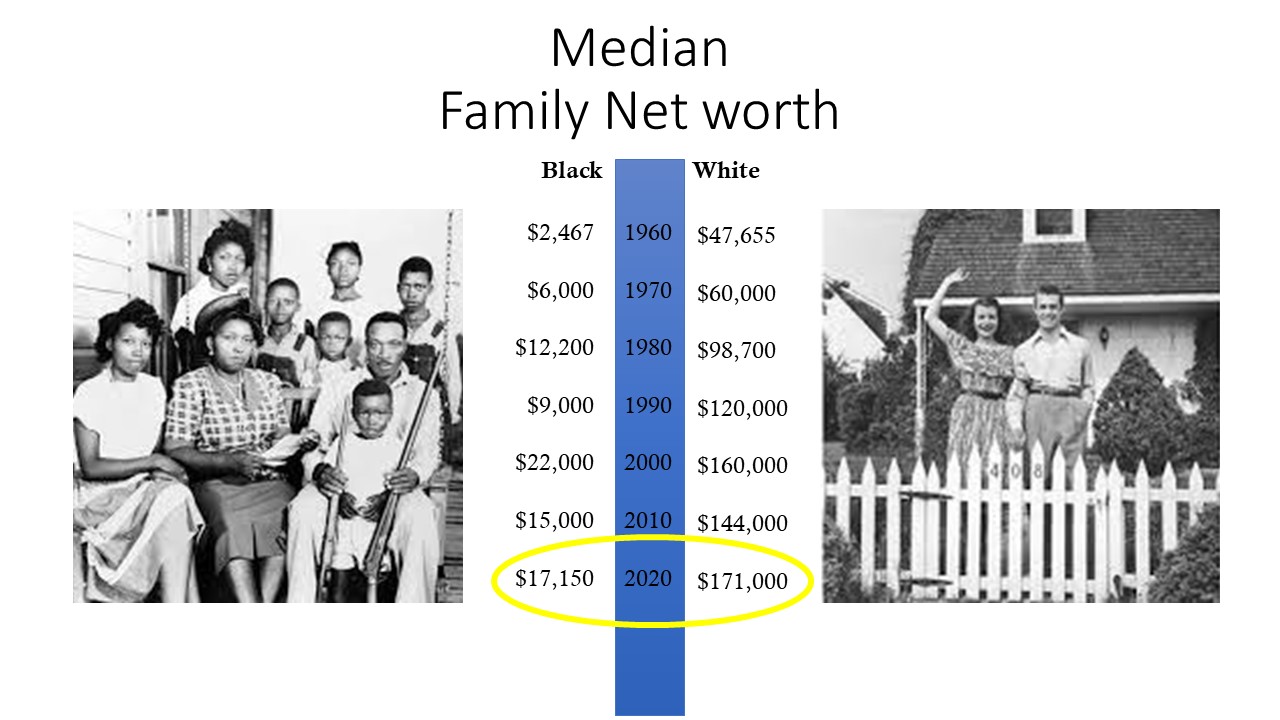
Recent figures show that white median net worth is roughly ten times Black median net worth. Let's look at barriers to Black prosperity over 400 years and see how the bootstrap argument stacks up.
There is, indeed, a strong economic basis for reparations.
Learn about the racial wealth gap, era-by-era:
Summary
The 10:1 racial wealth gap in the United States results from systemic and historical injustices which perpetuate economic inequality. Slavery laid the foundation for this disparity by forcibly extracting labor from African Americans without compensation. After emancipation, Black people faced systemic exclusion from wealth-building opportunities, such as land ownership and access to education. Policies like the Homestead Act offered land to millions of white families while denying Black families similar benefits, entrenching racial inequities in wealth accumulation.
Discriminatory practices like redlining and segregation deepened the racial wealth divide well into the 20th century. Banks and government programs systematically denied mortgages and loans to Black families, restricting their access to homeownership—the primary vehicle for wealth-building in the U.S. Suburban development and the post-war GI Bill further enriched white families while excluding Black veterans and communities. These practices forced many Black families into segregated neighborhoods. These neighborhoods faced both high tax levels and chronic disinvestment, which perpetuated cycles of poverty.
The racial wealth gap widened as economic policies favored white families. Employers routinely underpaid Black workers or relegated them to low-wage jobs, denying them opportunities to build wealth. Early union policies oftern blocked Black membership. Additionally, the criminal justice system disproportionately targeted Black people, often stripping them of economic stability through fines, incarceration, and employment barriers. These factors compounded over generations, creating lasting disparities in income, savings, and investments between white and Black households.
Structural barriers continue to uphold the 10:1 racial wealth gap. Tackling this disparity requires intentional economic policy reform, the dismantling of systemic barriers, and a comprehensive program of reparative justice.
Quote
For decades we have been told that hard work and greater effort on the part of black Americans, not systemic reform, is the key to closing the racial wealth gap. Earlier this month a poll from The Economist/YouGov found that 40% of whites think that blacks could be just as well off as whites if they only tried harder.
In a new report I co-authored with William Darity of Duke University and Darrick Hamilton of the New School, "What We Get Wrong About Closing the Racial Wealth Gap,” we state it to be false that trying harder, mimicking “successful” ethnic groups, or a number of other myths we address will correct the issue of growing wealth disparity. In our findings we systematically demonstrate that the narrative that places the onus of the racial wealth gap on black defectiveness is false in all of its permutations.
Antonio Moore, founder, Tonetalks
Commentary: What We Get Wrong on Closing the Racial Wealth Gap
Articles
Examining the Black-white wealth gap
Black Americans Are Losing Out On A $68 Trillion Wealth Transfer (blackenterprise.com)
One reason why America's wealth gap persists across generations : NPR
Commentary: What We Get Wrong on Closing the Racial Wealth Gap
The economic impact of closing the racial wealth gap
Why does the racial wealth gap matter? – Center for Public Integrity
Scholarly Studies
The Business Case For Racial Equity: A Strategy For Growth | Altarum
The economic impact of closing the racial wealth gap | McKinsey
Black wealth is increasing, but so is the racial wealth gap | Brookings
Closing The Racial Wealth Gap GPS Insights Report (citigroup.com)
Books
Closing the Wealth Gap: A Guide for Black Americans (15cents.info)
The Stolen Wealth of Slavery: A Case for Reparations by David Montero | Goodreads
The Color of Money: Black Banks and the Racial Wealth Gap by Mehrsa Baradaran | Goodreads
Questions for Research and Reflection:
- Is reparations the best means to close the racial wealth gap? Why or why not?
- What programs might best remediate the racial wealth gap? How?
- How can efforts for livable wages (i.e. the "fight for15") contribute to closing the racial wealth gap?
- How does underemployment exacerbate the racial wealth gap?
- Calculate your family's net worth. Then calculate the percentage you can attribute to intergenerational wealth transfer. List the ways your family has benefited from racist fiscal policy in the 20th century.
Summary
Black income suppression stems from historical and systemic practices that limit economic opportunities for Black workers. After emancipation, employers and local businesses and institutions imposed discriminatory practices like sharecropping and debt peonage, trapping Black workers in cycles of poverty. Local and federal agencies' refusal to enforce fair wages for Black laborers solidified income disparities and set a precedent for economic inequality.
Employers actively segregated workplaces and excluded African Americans from high-paying industries during the 20th century. Labor unions often barred Black workers from membership, limiting their access to better wages and protections. Companies also implemented discriminatory hiring and promotion practices, relegating African Americans to low-wage, unstable jobs. These systemic barriers blocked Black workers from achieving the economic mobility that many white workers enjoyed during industrial and economic growth periods.
Government policies also actively suppressed African American income. Legislators excluded Black workers from key labor protections like the Social Security Act and minimum wage laws during the New Deal era. Redlining and housing discrimination further limited job opportunities by forcing African Americans into under-resourced neighborhoods with fewer economic prospects. Public transportation was segregated and designed to fill the white commuter's needs. Public and private institutions consistently denied equal education and vocational training access, further restricting avenues to higher-paying careers.
While not as severe as in the early 20th century, income suppression still persists as employers and institutions continue discriminatory practices. Companies engage in wage disparities by paying Black workers less than their white counterparts for the same roles. Systemic inequities in education and access to capital restrict opportunities for African Americans to enter high-paying fields or start businesses. The ongoing impact of criminal justice policies also hinders income growth by disproportionately targeting Black individuals and creating barriers to employment after release. Addressing income suppression requires dismantling these discriminatory structures and implementing policies that ensure equitable economic opportunities.
Quote
"A common explanation for de facto segregation is that most black families could not afford to live in predominantly white middle class communities and are still are unable to do so. African American isolation, the argument goes, reflects their low incomes, not de jure segregation. Racial segregation will persist until more African Americans improve their educations and are able to earn enough to move out of high poverty neighborhoods.
The explanation at first seems valid. But we cannot understand the income and wealth gap that persists between African Americans and whites without examining governmental policies that purposely kept black incomes low throughout most of the 20th century. Once government implemented these policies economic differences became self perpetuating."
Richard Rothstein, The Color of Law
History of Economic Suppression and Inequality
Systematic Inequality and Economic Opportunity - Center for American Progress
Labor unions and Racism
Minimum wage and tipping
The Racist History of Tipping - POLITICO Magazine
The Racist, Twisted History of Tipping – Mother Jones
GCPI-MW-fact-sheet-2018.06.08.pdf
montialoux_jmp_2018.pdf (harvard.edu)
Social security
NAACP | Viewing Social Security Through The Civil Rights Lens
african_american_economic_security_and_the_role_of_social_security.pdf
National Recovery Act wage complicity – canning, cotton textile industry
“Black Labor and the Codes” - Teaching American History
National Labor Relations Act and Labor Board – exclusion of Blacks
Fair Labor Standards Act 1938
Farm Workers and the Fair Labor Standards Act: Racial Discrimination in the New Deal
Farm workers aren't paid overtime because of racist laws
Questions for Research and Reflection:
-
How have historical practices like slavery, sharecropping, and exclusion from labor protections shaped the ongoing patterns of income suppression for African Americans today?
-
In what ways have discriminatory hiring practices and workplace segregation perpetuated income disparities for African Americans across generations?
-
How have government policies, such as redlining and the exclusion of African Americans from New Deal protections, contributed to systemic barriers to economic advancement?
-
What role does education and access to professional networks play in perpetuating or addressing income suppression for African Americans?
- White students: how would your family's net worth look today if your ancestors' income had been suppressed? How does intergenerational wealth disparity affect society at large?
-
How can individuals, organizations, and policymakers actively work to dismantle the systems that continue to suppress African American incomes?
Summary - Wikipedia
Slavery in the United States was the legal institution of human chattel enslavement, primarily of Africans and African Americans, that existed in the United States of America from its founding in 1776 until passage of the Thirteenth Amendment in 1865.
************************************
Edward Baptist argues in his book, "The Half Has Never Been Told: Slavery and the Making of American Capitalism," that the forced migration and subsequent harsh treatment of slaves in the cotton fields was integral to establishing the United States as a world economic power.
"Slavery continues to have an impact on America in the most basic economic sense," Baptist told Here & Now's Jeremy Hobson. "We don't want to hear that at its root, the economic growth depends to a large extent on slavery."
Articles
The Transatlantic Slave Trade (eji.org)
Outreach Programme on the Transatlantic Slave Trade and Slavery | United Nations
The Disturbing Truth About Breeding Farms During Slavery (youtube.com)
Historical Context: Facts about the Slave Trade and Slavery (S. Mintz)
Letters from Black Americans to their former enslavers - The Washington Post
Books
The Half Has Never Been Told: Slavery and the Making of American Capitalism (Edward E. Baptist)
Slavery's Capitalism: A New History of American Economic Development (Sven Beckert)
River of Dark Dreams: Slavery and Empire in the Cotton Kingdom (Walter Johnson)
The Classic Slave Narratives (Henry Louis Gates Jr.)
Podcasts
‘1619,’ a Podcast From The New York Times
The History of American Slavery, with Jamelle Bouie and Rebecca Onion.
Voices from the Days of Slavery: Stories, Songs and Memories (Library of Congress)
Websites
Sources in U.S. History Online: (gale.com)
Black beyond data | Hub (jhu.edu)
North American Slave Narratives (unc.edu)
National Curriculum Unit: Slave Narratives
Home | Middle Passage Ceremonies and Port Markers Project
Slave Archival Collection Database
Memorial Sites
United Nations Outreach Programme on the Transatlantic Slave Trade and Slavery
CONTEMPORARY MONUMENTS TO THE SLAVE PAST
These 9 memorials trace the global impact of slavery
Drexciya: how Afrofuturism is inspiring calls for an ocean memorial to slavery
GROUP URGES ATLANTIC SEAFLOOR BE LABELED A MEMORIAL TO SLAVE TRADING
African Burial Ground - A Sacred Space in Manhattan
Middle Passage Ceremonies and Port Markers Project
Film/Videos
The Half Has Never Been Told | Edward E. Baptist
Questions for Research and Reflection:
- Did your ancestors participate (willingly or unwillingly) in the Atlantic Slave Trade in any way?
- Were they enslavers? Slavetraders? Enslaved people?
- Or, did they benefit/suffer from adjacency to slavery - for instance, in the import/export of goods like cotton, or in the manufacturing of textiles? In the finance or insurance industries?
- How did all white families benefit, either directly or indirectly from the enslavement of Africans?
- Once emancipated, what challenges do freed men and women face in earning a living and educating their children? How do these circumstances compare for whites?
- If you are white, can you trace any family benefits from that era? A tradition of quality education? Philanthropy?
- If you are Black, are there stories passed down about your family's resilience and tenacity? How did your family prevail against white supremacy?
Summary - Wikipedia
Anti-literacy laws in many slave states before and during the American Civil War affected slaves, freedmen, and in some cases all people of color.[1] Some laws arose from concerns that literate slaves could forge the documents required to escape to a free state. According to William M. Banks, "Many slaves who learned to write did indeed achieve freedom by this method. The wanted posters for runaways often mentioned whether the escapee could write."[2] Anti-literacy laws also arose from fears of slave insurrection, particularly around the time of abolitionist David Walker's 1829 publication of Appeal to the Colored Citizens of the World, which openly advocated rebellion,[3] and Nat Turner's slave rebellion of 1831.
The United States is the only country known to have had anti-literacy laws.[4]
Between 1740 and 1834 Alabama, Georgia, Louisiana, Mississippi, North and South Carolina, and Virginia all passed anti-literacy laws.[5] South Carolina prohibited teaching slaves to read and write, punishable by a fine of 100 pounds and six months in prison, via an amendment to its 1739 Negro Act.[6]
A website titled "Fight Municipal Court Abuse (court.rchp.com) includes the following in its list of significant anti-black laws:
- 1847, Missouri: Prohibited assembling or teaching slaves to read or write[7]
- 1829, Georgia: Prohibited teaching blacks to read, punished by fine and imprisonment[8]
- 1832, Alabama and Virginia: Prohibited whites from teaching blacks to read or write, punished by fines and floggings
- 1833, Georgia: Prohibited blacks from working in reading or writing jobs (via an employment law), and prohibited teaching blacks, punished by fines and whippings (via an anti-literacy law)
- 1847, Missouri: Prohibited teaching blacks to read or write[9]
***********************************
“Knowledge makes a man unfit to be a slave.”
―
Articles
How Literacy Became a Powerful Weapon in the Fight to End Slavery (C. Coleman)
Anti-literacy Laws -There Were Laws Against Teaching Blacks to Read? (J. C. Abercrombie)
Reading For the Enslaved, Writing For the Free: Reflections on Liberty and Literacy (E.J. Monaghan)
Self-Taught: African American Education in Slavery and Freedom (Heather A. Williams)
Books
Videos
"The Alphabet is an Abolitionist. If You Would Keep a People Enslaved, Refuse to Teach Them to Read"
The Legacy of Anti-Literacy Laws
Questions for Research and Reflection:
- In what ways does preventing or limiting Black literacy during the enslavement era contribute to intergenerational poverty?
- How does Black illiteracy figure into Black land theft or suppression of Black voting rights? What other effects might illiteracy have?
- How many generations of your family have gone to college? How did graduating influence your ancestors' choice of profession and income level?
- How does education allow for the transfer of generational wealth?
- Would you consider disinvestment in public schools a modern version of anti-Black literacy policy? Why or why not?
Summary - Wikipedia
The Homestead Acts were several laws in the United States by which an applicant could acquire ownership of government land or the public domain, typically called a homestead. In all, more than 160 million acres (650 thousand km2; 250 thousand sq mi) of public land, or nearly 10 percent of the total area of the United States, was given away free to 1.6 million homesteaders; most of the homesteads were west of the Mississippi River.
**************************
"It was never the case that a white asset-based middle class simply emerged. Rather, it was government policy, and to some extent literal government giveaways, that provided whites the finance, education, land and infrastructure to accumulate and pass down wealth."
Darrick Hamilton and Trevon Logan
The Homestead Act of 1862 (L.A. Potter, W. Schamel)
Homestead Act - Definition, Dates & Significance
Land and the roots of African-American Poverty (K.L. Merritt)
Race, Reconstruction, and Reparations (K. L. Merritt)
African American Homesteaders in the Great Plains
The Homestead Act: A Major Asset-Building Policy in American History (T. Williams)
The Land Grant System in Early Virginia
How Colonists Acquired Title to Land in Virginia
Books
Tracing Their Steps: A Memoir: (Bennett, Bernice Alexander, Bennett)
Bury My Heart at Wounded Knee: An Indian History of the American West, (Dee Brown)
Videos
1862: The Homestead Act, (Tim Wise)
The Homestead Act of 1862 contributed to the wealth gap in the U.S.
Search for Original Land Patents and Grants
Arphax - Family Maps and Texas Land Survey Maps - Genealogy History
Questions for Research and Reflection:
- Did your family acquire land patents or land grants from the 1600s - 1915? If so, how did these grants affect your family's financial status?
- Has land or real property been passed down in your family? Has the property appreciated over time?
- Enslaved people could not own property; after 1866, freedmen could apply for land grants, but less than 5% of land grants were awarded to African Americans. How does lack of land ownership affect African American net worth as we enter the 20th century?
- Does your family own land now? How and when was it acquired?
Summary - Wikipedia
Reconstruction, in U.S. history, the period (1865–77) that followed the American Civil War and during which attempts were made to redress the inequities of slavery and its political, social, and economic legacy and to solve the problems arising from the readmission to the Union of the 11 states that had seceded at or before the outbreak of war.
************************
“It was not, then, race and culture calling out of the South in 1876; it was property and privilege, shrieking to its own kind, and privilege and property heard and recognized the voice of its own.”
― Black Reconstruction in America 1860-1880
Articles
Erasing the Black Freedom Struggle (teachreconstructionreport.org)
EJI's Reconstruction in America Report Changes Picture of Lynching in America
How Reconstruction Still Shapes Racism in America (Henry Louis Gates Jr.)
How the Failure of Reconstruction Destroyed Progress in America (Annette Gordon-Reed)
What Everyone Should Know About Reconstruction (Tiffany M. Patterson)
Reconstruction - Civil War End, Changes & Act of 1867
Revisiting Reconstruction (Matthew Wills)
Reconstruction | American Civil War Museum
Civil War and Reconstruction, 1861-1877 (Eric Foner)
The Reconstruction Era and the Fragility of Democracy | Facing History and Ourselves
Reconstruction | Gilder Lehrman Institute of American History
150 Years and Counting | National Museum of African American History and Culture
The Battle of Liberty Place: White League Uprising Sept. 14, 1874 - The Reconstruction Era
About | Mapping The Freedmen's Bureau
Books
Black Reconstruction in America 1860-1880 (W.E.B. Du Bois)
Stony the Road: Reconstruction, White Supremacy, and the Rise of Jim Crow (Henry Louis Gates Jr.)
Reconstruction: America's Unfinished Revolution 1863-1877 (Eric Foner)
The Second Founding: How the Civil War and Reconstruction Remade the Constitution (Eric Foner)
The Souls of Black Folk: (W.E.B. Du Bois)
Podcasts
Reconstruction podcast, with Jamelle Bouie and Rebecca Onion
Podcast: Eric Foner on the "Fake History" of Reconstruction - The Reconstruction Era
Deconstructing The Myths Of Reconstruction
Film/Video
Reconstruction America After the Civil War
Reconstruction: America After the Civil War - PART 1
America After The Civil War....Reconstruction Pt 1 & 2
Henry Louis Gates Jr & Paula Kerger on Reconstruction: America After the Civil War | SXSW EDU
The Reconstruction Era and the Fragility of Democracy | Facing History and Ourselves
African American History in the Lowcountry: The Reconstruction Era
Reconstruction: The Vote | Black History in Two Minutes
Eric Foner on Reconstruction - Short
Questions for Research and Reflection:
- How does Field Order 15, the "40 Acres and a Mule" provision for land redress for freedmen initially affect Black self-sufficiency?
- What happens to freedmen's net worth when this order is rescinded?
- What happens to the land that had been awarded and then taken back?
- Do planters receive compensation for emancipation of their slaves? How does this affect their net worth?
Summary - Wikipedia
Black codes were strict local and state laws that detailed when, where and how formerly enslaved people could work, and for how much compensation. The codes appeared throughout the South as a legal way to put Black citizens into indentured servitude, to take voting rights away, to control where they lived and how they traveled and to seize children for labor purposes.
Jim Crow laws were a collection of state and local statutes that legalized racial segregation. Named after a Black minstrel show character, the laws—which existed for about 100 years, from the post-Civil War era until 1968—were meant to marginalize African Americans by denying them the right to vote, hold jobs, get an education or other opportunities. Those who attempted to defy Jim Crow laws often faced arrest, fines, jail sentences, violence and death.
******************************
“You can’t ‘get over’ something that is still happening. Which is why black Americans can’t ‘get over’ slavery or Jim Crow.”
― So You Want to Talk About Race
Articles
United States Slavery Laws and Restrictions
Constitutional Rights Foundation – Black Codes
Black Codes - Definition, Dates & Jim Crow Laws
Black Codes and Pig Laws | Slavery By Another Name
The Code Noir (The Black Code) · LIBERTY, EQUALITY, FRATERNITY: EXPLORING THE FRENCH REVOUTION
Opinion | The ‘Lost Cause’ That Built Jim Crow (Henry Louis Gates Jr.)
Jim Crow Era - A Brief History of Civil Rights in the United States
Jim Crow laws created ‘slavery by another name’ (Erin Blakemore)
Jim Crow Laws: Definition, Facts & Timeline
Books
American Nightmare: The History of Jim Crow (Jerrold M. Packard)
Jim Crow Laws (Leslie V. Tischauser)
The Rise and Fall of Jim Crow (Richard Wormser)
Stony the Road: Reconstruction, White Supremacy, and the Rise of Jim Crow (Henry Louis Gates Jr.)
Life Under the Jim Crow Laws (Charles George)
The Jim Crow Laws and Racism in United States History (David K. Fremon)
Podcasts
Remembering Jim Crow | American RadioWorks
Jim Crow, Lynching and White Supremacy | Teaching Tolerance
Film/Video
Jim Crow and America's Racism Explained
History in the First Person: Living Under Jim Crow Laws
What was it like growing up in Alabama under Jim Crow?
Museum
Jim Crow Museum - Ferris State University
Questions for Research and Reflection:
- How do Black Codes and Jim Crow Laws limit Black economic progress?
- How does the threat of violence and the prevalence of lynching repress Black advancement in society?
- How did Jim Crow laws benefit white families?
- Did your white family live in the Jim Crow South? What was the economic impact of Jim Crow laws for your family?
- Research Jim Crow type laws where your parents grew up. What laws were in place?
- Are there any Jim Crow era laws still on the books in your state?
Summary - Equal Justice Initiative
After the Civil War, slavery persisted in the form of convict leasing, a system in which Southern states leased prisoners to private railways, mines, and large plantations. While states profited, prisoners earned no pay and faced inhumane, dangerous, and often deadly work conditions. Thousands of Black people were forced into what authors have termed “slavery by another name” until the 1930s.
The Thirteenth Amendment to the U.S. Constitution, ratified in 1865, prohibited slavery and involuntary servitude, but explicitly exempted those convicted of crime. In response, Southern state legislatures quickly passed “Black Codes” – new laws that explicitly applied only to Black people and subjected them to criminal prosecution for “offenses” such as loitering, breaking curfew, vagrancy, having weapons, and not carrying proof of employment. Crafted to ensnare Black people and return them to chains, these laws were effective; for the first time in U.S. history, many state penal systems held more Black prisoners than white – all of whom could be leased for profit.
Examples
-
Chattahoochee Brick Company (Atlanta, Georgia): The Chattahoochee Brick Company used convict labor, including African American prisoners, in the production of bricks.
-
Parchman Farm (Mississippi State Penitentiary) - Parchman, Mississippi: Parchman Farm, also known as the Mississippi State Penitentiary, was notorious for its use of convict leasing. African American prisoners were subjected to harsh conditions and forced labor. For more information, you can visit the official website of the Mississippi Department of Corrections: www.mdoc.ms.gov.
-
Sugar Land (Imperial State Prison Farm) - Sugar Land, Texas: Sugar Land, located in Texas, was the site of the Imperial State Prison Farm where African American convicts were leased out for labor, primarily in the sugar cane fields. The site has since been repurposed, and the Sugar Land Heritage Foundation provides historical information: www.slheritage.org.
-
Angola Prison (Louisiana State Penitentiary) - Angola, Louisiana: Angola Prison in Louisiana had a history of convict leasing, with African American prisoners working in agriculture and other industries. The official website of the Louisiana Department of Public Safety and Corrections provides information about the prison: www.doc.louisiana.gov.
-
Cummins Unit (Arkansas Department of Corrections) - Grady, Arkansas: The Cummins Unit, part of the Arkansas Department of Corrections, employed convict labor, including African American prisoners, in various industries. The official website of the Arkansas Department of Corrections offers information about the facility: www.doc.arkansas.gov.
-
Rikers Island (New York City Department of Correction) - New York City, New York: While not specifically associated with convict leasing, Rikers Island in New York has a history of utilizing inmate labor, including African American prisoners, for various work assignments within the facility.
Articles
What is convict leasing? · Sugar Land Convict Leasing
The Origins of Modern Day Policing
Inside Mississippi’s notorious Parchman prison (Hannah Grabenstein)
Local historians honor forgotten railroad workers | Mountain Xpress
Books
Slavery Revisited: Blacks And The Southern Convict Lease System, 1865 1933 (Milfred C. Fierce)
One Dies, Get Another: Convict Leasing in the American South, 1866-1928 (Matthew J. Mancini)
The New Jim Crow: Mass Incarceration in the Age of Colorblindness (Michelle Alexander)
Worse Than Slavery: Parchman Farm and the Ordeal of Jim Crow Justice (David M. Oshinsky)
Parchman Farm: Photographs and Field Recordings: 1947-1959 (Bruce Jackson)
Podcasts
Episode 8: Zebulon Ward and Convict Leasing – The Reckoning
Black History for White People - Convict Leasing
Reframing History: Mass Incarceration - NPR Throughline
Film/Video
Slavery by Another Name: The Enslavement of Black Americans from the Civil War to World War II
Convict Leasing | Slavery By Another Name
Henry Louis Gates, Jr. - Convict Leasing | Black History in Two Minutes
Convict Leasing in America: Unearthing the Truth of the Sugar Land 95
Joseph House Lecture Series: Florida's Convict Lease System and its Legacy of Prison Abuse
Crucial Conversations: Burial Grounds
Convict Leasing, Forced Labor, Theft of Black Wealth: The Case of the Chattahoochee Brick Company
Sacred Site Ceremony - Chattahoochee Brick Company Consecration 4/3/2021
Museums
History of Angola — The Angola Museum at the Louisiana State Penitentiary
Questions for Research and Reflection:
- Do you agree that convict leasing is 'slavery by another name?' Why or why not?
- Do you think using prison labor to enrich for-profit employers should be allowed? State employers? Why or why not?
- How does convict leasing set the stage for post civil-rights era mass-incarceration programs? The "War of Drugs?"
- How does convict leasing compare to the modern-day criminal justice system in your area?
- How do sundown and vagrancy laws aid convict leasing schemes?
- In what ways are modern 'driving while Black' police stops similar to laws limiting Black travel from prior eras?
- Research whether there was convict leasing in place where your ancestors lived. What were conditions like?
- How does being arrested for vagrancy or sundown law or violation of other Jim Crow laws affect the ability to earn an income?
- Did any of your ancestors pass down stories from this era? What happened?
Summary - Slavery by Another Name, PBS
After the Civil War, former slaves sought jobs, and planters sought laborers. The absence of cash or an independent credit system led to the creation of sharecropping.
Sharecropping is a system where the landlord/planter allows a tenant to use the land in exchange for a share of the crop. This encouraged tenants to work to produce the biggest harvest that they could, and ensured they would remain tied to the land and unlikely to leave for other opportunities. In the South, after the Civil War, many black families rented land from white owners and raised cash crops such as cotton, tobacco, and rice. In many cases, the landlords or nearby merchants would lease equipment to the renters, and offer seed, fertilizer, food, and other items on credit until the harvest season. At that time, the tenant and landlord or merchant would settle up, figuring out who owed whom and how much
High interest rates, unpredictable harvests, and unscrupulous landlords and merchants often kept tenant farm families severely indebted, requiring the debt to be carried over until the next year or the next...
*********************************
What rent do you pay here?" I inquired. "I don't know, - what is it, Sam?" "All we make," answered Sam. It is a depressing place, - bare, unshaded, with no charm of past association, only a memory of forced human toil, - now, then, and before the war. They are not happy, these black men whom we meet throughout this region. There is little of the joyous abandon and playfulness which we are wont to associate with the plantation Negro. — W.E.B. Du Bois
Key laws and factors related to sharecropping:
1. Black Codes and Jim Crow Laws: Following the end of the Civil War, Black Codes and later Jim Crow laws in Southern states limited the economic opportunities and mobility of newly freed African Americans. These laws restricted land ownership, limited employment options, and reinforced a system that pushed many African Americans into sharecropping.
2. Crop Lien Laws: Crop lien laws, prevalent in Southern states, allowed landowners or merchants to provide credit to sharecroppers, often at high interest rates, using the anticipated crop yield as collateral. This system often resulted in indebtedness and dependency for sharecroppers.
3. Debt Peonage: Debt peonage, a practice prevalent in the South, allowed landowners or merchants to keep sharecroppers in perpetual debt by manipulating crop prices, charging inflated prices for goods, or using exploitative accounting practices.
4. Tenant Farming Acts: Some states enacted tenant farming acts to provide limited protection for sharecroppers and tenants. These laws regulated aspects such as contracts, evictions, and the rights and obligations of both landowners and sharecroppers.
5. Agricultural Adjustment Act (AAA): The Agricultural Adjustment Act of 1933, a federal law enacted during the Great Depression, aimed to support agricultural recovery. However, it often excluded sharecroppers and tenant farmers from receiving benefits, exacerbating their economic struggles.
It's important to note that sharecropping and related laws and practices were complex and varied regionally. Understanding the nuances and specific dynamics of sharecropping requires further research into state laws, local practices, and historical records from the relevant time periods and regions.
Articles
Sharecropping | Slavery By Another Name
Sharecropping Contract.pdf (gilderlehrman.org)
Sharecropping contract| NCpedia
Microsoft Word - reconstruct_formatted.doc (uh.edu)
Slavery by Another Name: The Economy of Sharecropping
Sharecropping - Definition, System & Facts
Sharecropping, Black Land Acquisition, and White Supremacy (1868-1900)
Books
The Origins of Southern Sharecropping (Edward Royce)
Revolt Among The Sharecroppers (Howard Kester)
Podcasts
American Capitalism: A History: 14.1. Sharecropping
Seal The Seasons, The History of Black Farmers
Film/Video
MOOC | Origins of Sharecropping | The Civil War and Reconstruction, 1865-1890
Lest We Forget: The Lost Story of Southern Sharecroppers
American Voices / Black America 01 - Sharecroppers
Sharecropping American History
Mary and Early Williams on Life as A Sharecropper : Voices of the Movement, Fayette County Tennessee
Sharecropper Life on a Plantation
Questions for Research and Reflection:
- If your family owned a plantation, did they engage in sharecropping agreements after emancipation? Do you have family records from this era?
- Did your family purchase or import goods from white farmers or sharecroppers?
- If your family were sharecroppers, were any stories passed down about that era? What happened?
- What are typical stipulations of sharecropping contracts? Are these arrangements fair?
- How does Black illiteracy compound the problem of sharecropping fraud?
- Does sharecropping allow Black farmers to amass wealth? Why or why not?
- How does sharecropping benefit white farmers?
Summary
The Freedman's Saving and Trust Company, popularly known as the Freedman's Savings Bank, was a private corporation chartered by the U.S. government to encourage and guide the economic development of the newly emancipated Negro communities in the post-Civil War period.
Although functioning only between 1865 and 1874, the company achieved notable successes as a leading financial institution for negroes. However, the white-run institution was never set up to truly grow the wealth of its Black depositors -- it was established only as a savings bank, meaning it did not lend money. When Henry Cooke took over as the bank’s finance chairman 1867, he began using its funds to finance the railroad industry without the knowledge of the depositors. In 1871, the bank’s managers lobbied Congress to deregulate and turn the institution into an investment bank, but the funds were used recklessly for speculation. All the while, the bank encouraged freedmen to increase their deposits to fuel their investments by promising better returns. A year after the Panic of 1873, which involved the failure of railroad investments, the bank went under, taking with it nearly $3 million in deposits, more than half of accumulated Black wealth. Its failure was devastating to the newly emancipated negro communities.
“Not even ten additional years of slavery could have done so much to throttle the thrift of the freedmen as the mismanagement and bankruptcy of the series of savings banks chartered by the Nation for their special aid.” - W.E.B. Du Bois
Its archives are valuable as a large collection of information regarding the applicants and what was known of them including some physical descriptions of complexion, where they were born and also names of family members in the immediate aftermath of emancipation. The bank maintained 37 offices in 17 states, and deposits peaked at $57 million from 70,000 depositors.
John Mercer Langston, one of the bank’s black trustees, wrote in his 1894 autobiography, “Perhaps the failure of no institution in the country … has ever wrought larger disappointment and more disastrous results to those interested in its creation.”
Timeline of Events Related to the Freedman's Savings Bank Collapse:
1. March 3, 1865: The Freedman's Savings and Trust Company, commonly known as the Freedman's Savings Bank, is established by an act of Congress. It aimed to provide financial services and promote savings among newly emancipated African Americans.
2. 1870s: The bank expands rapidly, opening numerous branch offices across the United States. It becomes a significant institution for African American depositors, handling millions of dollars in deposits.
3. Late 1873: Economic recession hits the United States, leading to financial difficulties for many banks, including the Freedman's Savings Bank. Mismanagement, speculative investments, and embezzlement contribute to the bank's decline.
4. June 29, 1874: The Freedman's Savings Bank officially closes its doors, declaring bankruptcy. Thousands of African American depositors lose their savings, amounting to an estimated $3 million (equivalent to approximately $68 million in 2021).
5. Aftermath and Fallout: The bank's collapse has devastating effects on African American communities. Many depositors, who had entrusted their savings to the bank, are left impoverished and disillusioned. Investigations and legal battles follow, uncovering instances of fraud, mismanagement, and negligence.
6. Legislative Response: In 1874, Congress passes a resolution establishing a commission to investigate the bank's failure and provide recommendations for compensating depositors. However, due to political and financial constraints, only a fraction of the depositors' losses are repaid.
7. Impact on Trust and Savings Institutions: The failure of the Freedman's Savings Bank erodes trust in African American-owned banks and savings institutions, making it more challenging for these institutions to secure deposits and operate successfully.
8. Legacy: The collapse of the Freedman's Savings Bank serves as a cautionary tale and highlights the vulnerability of marginalized communities to financial exploitation. It underscores the importance of financial literacy, regulatory oversight, and equitable access to banking services.
It is important to note that this timeline provides a broad overview of the major events related to the Freedman's Savings Bank collapse.
Articles
22 million reasons black America doesn’t trust banks (Marcus Anthony Hunter)
The Freedman’s Bank Was a First Step for Newly Freed Black Citizens (Julie Huffman)
On Jun 28, 1874: Freedmen’s Bank Fails, Devastating Black Community
Freedmen’s Savings and Trust Company (1865-1874) (Ryan Hurst)
Books
The Color of Money: Black Banks and the Racial Wealth Gap (Mehrsa Baradaran)
Podcasts
Film/Video
History of the Freedman's Bank
VIDEO: The story one of the worst robberies in American history: The Freedman's Bank
Freedman's Bank 150th Anniversary Celebration
Banking Black Part 1-Freedman's Bank: Black Owned History
Additional Resources
United States, Freedman's Bank Records, 1865-1874
African American Freedman's Savings and Trust Company Records
The Freedman's Savings and Trust Company and African American Genealogical Research
Mapping the Freedmen’s Bureau: Freedman’s Bank Branches (map)
Questions for Research and Reflection:
- Do you think racism figured into the mismanagement of funds held by the Freedmen's Savings and Trust? Why? How?
- How does the bankruptcy contribute to Black distrust of the government as well as white people?
- How does the failure of the Freedman's Savings and Trust affect Black economic progress in 1877? How does it affect the acquisition and transfer of generational wealth? Financial literacy?
- Once the bank fails, what do African American's do with their savings?
- What would have happened to your family if it had lost its life savings then?
Summary - Wikipedia
The Tulsa race massacre (known alternatively as the Tulsa race riot, the Greenwood Massacre, the Black Wall Street Massacre, the Tulsa pogrom, or the Tulsa Massacre)[9][10][11][12][13][14] took place on May 31 and June 1, 1921, when mobs of white residents, many of them deputized and given weapons by city officials, attacked black residents and businesses of the Greenwood District in Tulsa, Oklahoma.[1] It has been called "the single worst incident of racial violence in American history".[15] The attack, carried out on the ground and from private aircraft, destroyed more than 35 square blocks of the district—at that time the wealthiest black community in the United States, known as "Black Wall Street".[16]
More than 800 people were admitted to hospitals, and as many as 6,000 black residents were interned in large facilities, many of them for several days.[17][18] The Oklahoma Bureau of Vital Statistics officially recorded 36 dead.[19] A 2001 state commission examination of events was able to confirm 39 dead, 26 black and 13 white, based on contemporary autopsy reports, death certificates and other records.[1]:114 The commission gave several estimates ranging from 75 to 300 dead.[1]:13, 23[20]
********************************
Brenda Alford, whose grandparents survived the massacre but lost their businesses, went most of her life not knowing what happened in Greenwood. Before the massacre, her grandparents owned a shoe shop, as well as a record store, dance pavilion and community skating rink, Alford tells Here & Now’s Robin Young.
“They lost everything,” she says. “My reality every day of my life is that if they had not survived that day, I wouldn't be talking to you right now.”
A Survivor's Granddaughter Reflects On Tulsa Race Massacre: 'It Was A Horrendous Situation'
Articles
US: Failed Justice 100 Years After Tulsa Race Massacre | Human Rights Watch
Tulsa race massacre at 100: an act of terrorism America tried to forget
Opinion | What the Tulsa Race Massacre Can Teach Us - The New York Times
Why Black wealth has stayed 'relatively flat' since Tulsa massacre
The 1921 Tulsa Race Massacre and its enduring financial fallout
How America’s Vast Racial Wealth Gap Grew: By Plunder
Remembering ‘Red Summer,’ when white mobs massacred Blacks from Tulsa to D.C.
Tulsa's 'Black Wall Street' Flourished as a Self-Contained Hub in Early 1900s
Black Wall Street | Greenwood Cultural Center
What to Know About the Tulsa Greenwood Massacre
Tulsa searches for “Original 18” Black people killed during 1921 race massacre
The Tulsa Race Massacre Went Way Beyond “Black Wall Street”
Tulsa Race Riot: A Report by the Oklahoma Commission to Study the Race Riot of 1921
Books
Holocaust in the Homeland: Black Wall Street's Last Days (Corinda Pitts Marsh)
Black Wall Street (Hannibal B. Johnson)
The Burning: Massacre, Destruction, and the Tulsa Race Riot of 1921: (Madigan, Tim)
Race riot 1921: Events of the Tulsa disaster by Mary E. Jones Parrish
Riot and Remembrance: The Tulsa Race War and Its Legacy by James S. Hirsch
The Great Oklahoma Swindle: Race, Religion, and Lies in America's Weirdest State by Russell Cobb
They Came Searching by Eddie Faye Gates
Tulsa, 1921: Reporting a Massacre by Randy Krehbiel
Podcasts
Podcast | Dreams of Black Wall Street
Reggie Turner "Before They Die!" The Tulsa Race Riot of 1921
The Tulsa Race Massacre: 99 Years Later - Reggie Turner
Exploring Black Wall Street and the Tulsa Race Massacre in a New Podcast
Stuff You Missed in History Class - The Tulsa Race Riot and Black Wall Street
Film/Video
The Tulsa Race Riots | Black History in Two Minutes
Lush Presents: Greenwood Is Still Burning (youtube.com)
The Tulsa Race Massacre: 100 years Later #ReparationsNow
Tulsa Race Massacre Centennial
Tulsa Race Massacre Centennial Commemoration | NBC News
1921 Tulsa Race Massacre Centennial Commission - REMEMBERING BLACK WALL STREET
Congress Hears From Survivors Of Tulsa Greenwood Race Massacre On Centennial Of Riot (long)
Watch Goin' Back To T-Town | American Experience |
How Tulsa's Greenwood massacre echoes today
Black Wall Street: The Hidden Economy
Tulsa Race Massacre, 100 years later: Why it happened and why it's still relevant today
Oldest survivor of Tulsa race massacre testifies before House committee: "I have lived through th…
Black Wall Street - Full Documentary
VERY RARE Footage of Black Wall Street, Before The 1921 Tulsa Race Riot
Black Wall Street~Footage Massacre,Tulsa OK 1921, Historical Black Towns BlackHistoryUniversity.com
Websites
Black Wall Street | Greenwood Cultural Center
1921 Tulsa Race Massacre - Tulsa Historical Society & Museum
Further Racial Violence and Massacres
Elaine Massacre of 1919 - Encyclopedia of Arkansas
The Elaine Massacre: A Teach-In with Dr. Jemar Tisby
‘We want our land back’: for descendants of the Elaine massacre, history is far from settled
On Sep 30, 1919: Hundreds of Black People Killed in Elaine, Arkansas, Massacre (eji.org)
Black Massacres in the U.S. – The Decolonial Atlas
Questions for Research and Reflection:
- Why have white people continually attacked successful Black towns and enclaves?
- How did white people benefit from the destruction of Black Wall Street?
- Were any of the victims of Black Wall Street compensated for their losses?
- Who perpetrated the violence during Black Wall Street?
- If your family had suffered a similar attack, how would that have affected their net worth? Would they have received compensation? From whom?
- What would happen if Black residents were to destroy an entire white community? Why?
Summary - The Miller Center
Did the New Deal improve the lot of African Americans? The record is mixed. The aid provided by the New Deal to America's poor—black and white—was insufficient. Racism reared its head in the New Deal, often because federal programs were administered through local authorities or community leaders who brought their own racial biases to the table. The Agricultural Adjustment Administration (AAA) offered white landowners cash for leaving their fields fallow, which they happily accepted; they, however, did not pass on their government checks to the black sharecroppers and tenant farmers who actually worked the land. Even in the North, black people found that New Deal programs did not always treat them as well as whites.
Articles
The Next New Deal Must Be for Black Americans, Too - Bloomberg
Digital History-African Americans and the New Deal
FDR and The New Deal | Slavery By Another Name
How the New Deal Left Out African-Americans
It’s Time For a Black New Deal
“Black Cotton Farmers and the AAA”
NAACP | Viewing Social Security Through The Civil Rights Lens
african_american_economic_security_and_the_role_of_social_security.pdf
Systematic Inequality and Economic Opportunity - Center for American Progress
The New Deal: Designed for Jim Crow | HuffPost
The New Deal as raw deal for blacks in segregated communities - The Washington Post
Opinion | The New New Deal and Old Pitfalls - The New York Times (nytimes.com)
Books
The Hidden Rules of Race: Barriers to an Inclusive Economy (Andrea Flynn)
Podcasts
The New Deal and African Americans | The Takeaway | WNYC Studios
A 'Forgotten History' Of How The U.S. Government Segregated America : NPR
Film/Video
FDR and The New Deal | Slavery By Another Name
How the New Deal Left Out African-Americans
African American Civil Rights during the New Deal
Undoing the New Deal: African-Americans, Racism and the FDR/Johnson Reforms
Questions for Research and Reflection:
- How did the Agricultural Adjustment Act affect Black sharecroppers? White farmers?
- Might the ability, on the part of the Federal government, to blame white farmers for not sharing benefits received under the Act be a way for the government to claim the Act was not racist? Why or why not?
- In what ways was the new social security net unfair to Black Americans? Do these disparities still exist today?
- In what industries were the effects of discrimination the most pronounced for Black workers?
Summary - Wikipedia
Heir property is a legal term in South Carolina Lowcountry in the United States for land that is owned by two or more people, usually people with a common ancestor who has died without leaving a will. It is the leading cause of involuntary land loss among African Americans.[1]
As a general rule, heir property is rural land owned by African Americans who either purchased or were deeded land after the American Civil War.[2][3] When the land owner died, rather than using the formal system of taking a will and testament to the probate courts to ensure that the land was passed down to the landowners' children, the property was handed down informally. In this system, the land is held in common.[4] After several generations, it can be difficult to determine who the legal owners are, and the legal owners might not have paid their share of taxes, lived on the land, or helped maintain it.[4]
Here is a partial list of Heir's Property Laws, along with the state and date of enactment, and the consequences they have had on Black landowners:
1. Louisiana Heirship Law (1805): Enacted in Louisiana, this law introduced the concept of forced heirship, which required equal inheritance among heirs. While initially intended to protect family land ownership, it had unintended consequences for Black landowners, often leading to undivided and collectively owned property, making it difficult to secure financing or sell the land.
2. South Carolina Partition Law (1868): The Partition Law in South Carolina allowed for the division of jointly owned property among heirs. However, due to historical inequalities and limited access to legal representation, Black landowners often faced challenges in defending their rights and protecting their interests, resulting in the loss of land through forced sales or auctions.
3. Georgia's 1867 Homestead Exemption Law: Although not specific to heir's property, this law provided a homestead exemption to protect a certain amount of property from creditors. However, the exemption did not apply to land that was jointly owned, impacting Black landowners who often held property collectively and leading to the loss of ancestral land due to debts or foreclosure.
4. Uniform Partition of Heirs Property Act (UPHPA): The UPHPA is not a specific state law but a model law that several states have enacted to address the issues surrounding heir's property. As of September 2021, 18 states have enacted versions of the UPHPA. The consequences of not having such laws in place include the vulnerability of Black landowners to forced sales, lack of clear title, and potential loss of land due to partition actions.
It's important to note that these are just a few examples, and the consequences faced by Black landowners can vary from state to state depending on specific laws, historical context, and access to legal resources. Heir's property laws have often disproportionately affected Black landowners, leading to land loss, limited economic opportunities, and challenges in accessing resources such as loans and government assistance programs.
Articles
Sewage Crisis in Alabama’s Black Belt Spawns Complaint - Capital B (capitalbnews.org)
Watch Silver Dollar Road Online | 2023 Movie | Movies.Guide
Juneteenth reminds us of the lingering inequities surrounding ‘heirs’ property’ | The Hill
Black Lands Matter: The Movement to Transform Heirs’ Property Laws
Heirs' Property - Farmland Access Legal Toolkit
The reality of Black land loss
Eminent Domain | Wex | US Law | LII / Legal Information Institute
The Truth Behind '40 Acres and a Mule' | African American History Blog
Chronology | Harris Neck Land Trust
New Laws Help Rural Black Families Fight for Their Land
National farm groups push for increased Black land ownership
Books
Heirs' Property in the African American Community (Anderson Jones)
Wandering in Strange Lands: A Daughter of the Great Migration Reclaims Her Roots (Morgan Jerkins)
Podcasts
Special Edition Podcast: Heirs' Property - Federal Reserve Bank of Atlanta
Land Speculators Are Legally Forcing Black Southerners Off Family Land
Film/Video
The Biggest Problem You've Never Heard Of - Examining Heirs Property and Black Property Loss
Hicks Family Preserve - A Heirs Property Case Study
What is Heirs Property Law? | Lewis on the Law
How Property Law Is Used to Appropriate Black Land
Americans: Many Rivers to Cross
Websites
Center for Heirs Property Preservation | South Carolina
Center for Heirs Property Preservation | South Carolina
Our Work - Reparations Project
Georgia Heirs Property Law Center
Questions for Research and Reflection:
- How have white farmers and developers taken advantage of Black owners of heirs' property?
- How does owning heirs' property affect intergenerational Black wealth?
- How does the limited access to financial and real estate education affect Black property retention in the south?
- How does the loss of Black farmland benefit white farmers? Corporations?
Summary:
“The Color Of Law” demonstrates that racially explicit government policies to segregate our metropolitan areas are not vestiges, are neither subtle nor intangible, and were sufficiently controlling to construct the de jure segregation that is now with us in neighborhoods and hence in schools. The core argument of this book is that African Americans were unconstitutionally denied the means and the right to integration in middle class neighborhoods, and because this denial was state sponsored, the nation is obligated to remedy it.
Richard Rothstein, The Color of Law
Articles
Redlining
A 'Forgotten History' Of How The U.S. Government Segregated America
Interactive Redlining Map Zooms In On America's History Of Discrimination
Mapping Louisville's Redlining History
How Redlining’s Racist Effects Lasted for Decades
1934–1968: FHA Mortgage Insurance Requirements Utilize Redlining
How a New Deal Housing Program Enforced Segregation
The Racist Housing Policy That Made Your Neighborhood
Veteran’s Administration & Mortgages
How the GI Bill's Promise Was Denied to a Million Black WWII Veterans
How African American WWII Veterans Were Scorned By the G.I. Bill
Segregation By Covenant and Municipal Ordinance
How the Government Segregated America's Cities By Design
Segregation Ordinances: Birmingham, AL
The rise and demise of racially restrictive covenants in Bloomingdale
Detroit Housing Discrimination.pdf
Race Restrictive Covenants in Property Deeds | Connecticut History
Interactive Redlining Map Zooms In On America's History Of Discrimination
2020.7.31_-_confronting_racial_covenants_-_yale.city_roots_guide.pdf
From Ferguson to Baltimore: The Fruits of Government-Sponsored Segregation
Segregation and Effects on Education
Exclusionary zoning ordinances/creation of white suburbs
Microsoft Word - silver -- racialoriginsofzoning.doc
Understanding Exclusionary Zoning and Its Impact on Concentrated Poverty
Race, Ethnicity, and Discriminatory Zoning
Reverse redlining – subprime mortgages in AA communities
Reverse Redlining and the Destruction of Minority Wealth – Michigan Journal of Race & Law
The Social Structure of Mortgage Discrimination
"Reverse Redlining in the Subprime Mortgage Market: Comments on <i>Movi" by Cathy Lesser Mansfield
Single family housing ordinances and segregation
The racist roots of single-family zoning
Single-family housing linked to racial segregation: report
Segregated Suburbia: The Single-Family Home and the Struggle for Integrated Housing
Blockbusting
Blockbusting – Urban Studies 101 (cuny.edu)
Housing ‘Contract Sales’ and Installment Loan Fraud
Contract Buying Robbed Black Families In Chicago Of Billions
The infamous practice of contract selling is back in Chicago
Contract Buying and Blockbusting · Civil War to Civil Rights Chicago
Public Housing & Segregation
Race and public housing: Revisiting the federal role | Economic Policy Institute
Public Housing: Government-Sponsored Segregation
Government-Sponsored Segregation Created Today's Ghettos
Opinion | America’s Federally Financed Ghettos
Black community erasure – state highways, urban renewal
CuriosiD: How A 1900s Black Detroit Community Was Razed For A Freeway
The Road to Disinvestment: How Highways Divided the City and Destroyed Neighborhoods
The Avery Review | The Bottom: The Emergence and Erasure of Black American Urban Landscapes
Unequal Appraisal Valuation and Taxation
Black Homeowners Face Discrimination in Appraisals
The devaluation of assets in black neighborhoods
Race Gap in Home Appraisals Has Doubled Since 1980
Black Homeowners Pay More Than Fair Share in Property Taxes
Higher Property Taxes: Homeownership Costs More For Black Families
Tax Lien Sales | NAACP Legal Defense and Educational Fund
Racial Disparities in Home Appreciation
Books
The Color of Law: A Forgotten History of How Our Government Segregated America: (Rothstein, Richard)
Podcasts
In The Thick: The Legacy of Redlining
Film/Video
VIDEO: Housing Segregation In Everything : Code Switch : NPR
Richard Rothstein - "The Color of Law: A Forgotten History of How Our Government Segregated America"
How Redlining Shaped Black America As We Know It | Unpack That
Redlining and Racial Covenants: Jim Crow of the North
Questions for Research and Reflection:
- Did your family qualify for housing and mortgage benefits in the 1930s - 1960? What programs did they utilize?
- Did your family qualify for and receive a VA loan through the GI Bill? Was the process easy?
- How did purchasing real estate affect your family's net worth and socioeconomic status?
- Research redlining maps in the city you grew up in. What is the redlining status of your childhood neighborhood?
- Research neighborhood covenants where you grew up. Were their any racial covenants?
- Were there any Black families living on your block when you were a child? Now? Why or why not?
- Research urban renewal and transportation projects in your hometown. Where any Black communities bisected or razed?
- Research single family zoning codes in your neighborhood. How do these codes affect segregation in your neighborhood?
- What HOA rules/guidelines could be seen as ways to keep people of color from moving into a community?
- How might the erasure of thriving Black communities affect Black net worth?
Summary - Wikipedia
African American veterans benefited less than others from the G.I. Bill.
The G.I. Bill aimed to help American World War II veterans adjust to civilian life by providing them with benefits including low-cost mortgages, low-interest loans and financial support. African Americans did not benefit nearly as much as White Americans. Historian Ira Katznelson argues that "the law was deliberately designed to accommodate Jim Crow".[27] In the New York and northern New Jersey suburbs 67,000 mortgages were insured by the G.I. Bill, but fewer than 100 were taken out by non-whites.[28][29]
Additionally, banks and mortgage agencies refused loans to blacks, making the G.I. Bill even less effective for blacks.[30] Once they returned from the war, blacks faced discrimination and poverty, which represented a barrier to harnessing the mortgage and educational benefits of the G.I. Bill, because labor and income were immediately needed at home.
Most southern university principals refused to admit blacks until the Civil Rights revolution. Segregation was legally mandated in that region. Colleges accepting blacks in the South initially numbered 100. Those institutions were of lower quality, with 28 of them classified as sub-baccalaureate. Only seven states offered post-baccalaureate training, while no accredited engineering or doctoral programs were available for blacks. These institutions were all smaller than white or non-segregated universities, often facing a lack of resources.[31]
************************************
"First a Negro... Incidentally a Veteran"
David K. Onkst
Articles
How the GI Bill widened the Black-white wealth gap - Los Angeles Times (latimes.com)
How the GI Bill's Promise Was Denied to a Million Black WWII Veterans
After-the-War-Blacks-and-the-GI-Bill.pdf
The G.I. Bill, World War II, and the Education of Black Americans
The Inequality Hidden Within the Race-Neutral G.I. Bill
A homecoming without the home: How the GI Bill left out a million Black veterans
How African American WWII Veterans Were Scorned By the G.I. Bill
Returning From War, Returning to Racism
GI Bill opened doors to college for many vets, but politicians created a separate one for Blacks
Books
African Americans and the G.I. Bill (Jesse Russell)
Podcasts
The Road to Now - #118 The GI Bill and the Legacy of Racial Discrimination w/ Louis Woods
Film/Video
Lumina Podcast episode 24: Supporting Veterans and the GI Bill
Uneducated & Unwelcome: The G I Bill in the Segregated South
Why the G I Bill didn't benefit 1 million Black WWII Veterans; H.R.40 (Michael Imhotep)
Questions to Consider:
- What sort of reception did African Americans receive upon their return after WWII? How did this differ from white veterans?
- Why were education benefits apportioned so differently to white vs Black veterans? How and where did these disparities take place?
- What industries were complicit in ensuring African American veterans were denied full access to the benefits of the GI Bill after WWII?
- Did your white ancestors receive benefits under the GI bill? What were they? How did they affect your family's net worth?
Summary - Wikipedia
"Sundown towns" were historically communities in the United States where African Americans and other minority groups were explicitly or implicitly excluded, and they were often subject to racial violence or harassment if found within the town after sunset.
*********************************
“Our governments openly favored white supremacy and helped to create and maintain all-white communities. So did most of our banks, realtors, and police chiefs. If public relations offices, Chambers of Commerce, and local historical societies don’t want us to know something, perhaps that something is worth learning. After all, how can we deal with something if we cannot even face it?”
― Sundown Towns: A Hidden Dimension of American Racism
Here are a few examples:
- Anna, Illinois
- Cairo, Illinois
- Cicero, Illinois
- Vidor, Texas
- Forsyth County, Georgia
- Harrison, Arkansas
- Cape Charles, Virginia
- Pierce City, Missouri
- Grosse Pointe, Michigan
- Gardendale, Alabama
The existence of sundown towns has played a significant role in perpetuating and contributing to the racial wealth gap in the United States. Here are a few ways in which sundown towns relate to the racial wealth gap:
1. Exclusion from Housing Opportunities: Sundown towns enforced residential segregation, preventing African Americans from living in certain communities. This exclusion denied them access to neighborhoods with better resources, quality education, and employment opportunities. As a result, African Americans were often confined to under-resourced areas, limiting their ability to build wealth through home equity and property ownership.
2. Restricted Economic Opportunities: Sundown towns restricted African Americans' ability to work and operate businesses within their boundaries. This limited their economic opportunities, stifled entrepreneurship, and restricted their ability to accumulate wealth and assets over time.
3. Property Devaluations: The presence of sundown towns and the associated racial discrimination had an impact on property values in surrounding areas. Homes in predominantly African American neighborhoods were often undervalued, leading to decreased wealth accumulation through homeownership.
4. Inter-generational Wealth Transfer: The exclusionary practices of sundown towns limited African Americans' ability to pass down inter-generational wealth. The lack of access to homeownership, higher-paying jobs, and other wealth-building opportunities hindered the ability to accumulate and transfer assets, contributing to the racial wealth gap.
5. Intergenerational Impact: The consequences of sundown towns and their discriminatory practices have had long-lasting effects. The limited economic opportunities and denied access to resources endured by earlier generations continue to affect the current wealth and socioeconomic status of African American families.
It is important to acknowledge that sundown towns were just one of the many factors contributing to the racial wealth gap. Historical and ongoing systemic racism, discriminatory policies, education disparities, and other socio-economic factors have also played significant roles. Addressing these systemic issues is crucial to addressing and narrowing the racial wealth gap in the United States.
Articles
Sundown Towns: The Past and Present of Racial Segregation (J. Loewen, F. Kaplan, R. Smith)
AP Roadtrip: Racial Tensions in America's Sundown Towns (T. Sullivan, N. Nasir)
Sundown Towns - An Introduction
Books
“Sundown Towns” (James Loewen)
Overground Railroad: The Green Book & Roots of Black Travel in America (Candacy A. Taylor)
Videos
BridgeDetroit talks with Dr. James Loewen about Sundown Towns in the US
Sundown towns: uncovering Colorado's dark past
This former sundown county expelled 1,100 black residents in a racial cleansing
The Shameful Phenomenon of Sundown Towns - YouTube
The Injustice Files: Sundown Towns
Podcasts
The Human Together Podcast Show - Sundown Towns: Knowing the past to change the future
Viewpoints Radio - Racial Segregation in ‘Sundown Towns’
Sundown Towns by State
Wikipedia: Sundown Towns by State
Sundown Towns in the United States (tougaloo.edu)
Get Involved
Get involved in researching sundown towns
More Information on Sundown Towns
Reparative Acts
City Resolution Apologizes for Past Discrimination | Outlook Newspapers
Questions for Research and Reflection:
- What was the purpose of sundown ordinances?
- What is the difference between sundown towns and demographically all-white towns? Why is this distinction important?
- List the many ways sundown towns restricted African Americans' civil rights.
- How were these ordinances enforced?
- What happened to Black people in violation of sundown ordinances?
- How did Sundown Ordinances affect Black autonomy? The ability to connect with family members and friends? The ability to work?
- Research towns and cities your ancestors lived in. What sundown ordinances were in effect?
- Are there any Sundown Ordinances still on the books in your state?
- What effect on Black net worth might Sundown Ordinances have? Why?
- How might municipalities repair the damages caused by sundown ordinances?
"It was never the case that a white asset-based middle class simply emerged. Rather, it was government policy, and to some extent literal government giveaways, that provided whites the finance, education, land and infrastructure to accumulate and pass down wealth."